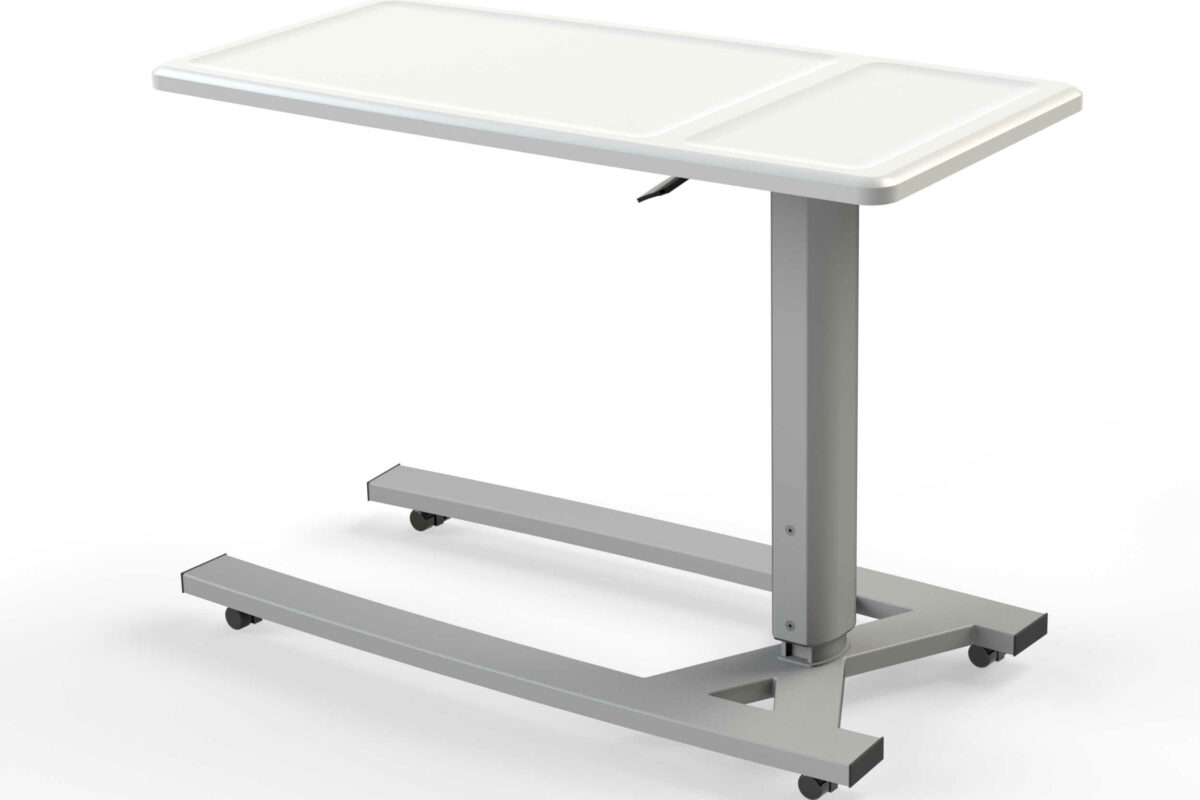
Why medViron Uses KYDEX® Instead of Solid Surface Tops in Healthcare Equipment

When evaluating work surfaces for healthcare equipment, solid surface materials are often assumed to be the best solution. In many cases, this assumption is rooted in past problems with rigid thermofilm or thermofoil tops—particularly delamination, edge separation, and surface failure after repeated cleaning.
Before defaulting to solid surface, it’s worth asking a more fundamental question: what problem is the facility trying to solve? In most cases, the answer is durability, cleanability, and long-term reliability in demanding clinical environments. MedViron uses KYDEX® thermoplastic on all horizontal surfaces because it addresses those concerns directly—without introducing the drawbacks that often accompany solid surface materials.
The Real Reason Solid Surface Is Often Specified
Solid surface materials are frequently specified as a response to failures seen in older surface technologies. Rigid thermofilm tops can delaminate over time, and urethane or edge-banded surfaces may separate from the substrate exposing the core material beneath.
While solid surface can mitigate some of these issues, it also introduces new challenges that are often overlooked during specification.
Limitations of Solid Surface in Healthcare Applications
Solid surface materials are not inherently optimized for mobile healthcare equipment or frequently adjusted surfaces. Several characteristics make them less suitable for these applications:
- Weight: Solid surface is heavy, which increases the effort required for patients or caregivers to adjust overbed tables or mobile equipment.
- Brittleness: Solid surface materials can be brittle and are subject to cracking or breakage under impact—an important consideration in busy healthcare environments.
- Warranty limitations: Many solid surface manufacturers do not warranty their products for mobile applications.
- Cost: Solid surface tops can significantly increase overall product cost, in some cases doubling the dealer price without providing proportional performance benefits.
These factors often make solid surface a less practical choice when evaluated across the full lifecycle of healthcare equipment.
Why MedViron Uses KYDEX® on All Horizontal Surfaces
MedViron thermoforms KYDEX® thermoplastic on all horizontal surfaces because it provides durability, cleanability, and reliability without the drawbacks associated with solid surface materials.
KYDEX offers several advantages that are particularly well-suited to healthcare environments:
- Greater thickness and durability: KYDEX is approximately four times thicker than rigid thermofilm, providing increased impact resistance and long-term durability.
- Impact resistance: KYDEX is more impact-resistant than brittle materials such as HPL, making it better suited for the rigors of daily clinical use.
- Chemical resistance: KYDEX withstands all grades of EPA-registered hospital cleaners and disinfectants without degrading.
- Seamless surface: Thermoformed KYDEX creates a seamless surface, eliminating edge banding, T-molding, or urethane edges that can fail over time.
- Fire performance: KYDEX carries a Class A / Class 1 fire rating, indicating a flame spread rating between zero and 25—the highest classification available for materials of this type.
- Indoor air quality: KYDEX is GREENGUARD Gold Certified, meeting stringent VOC emission criteria appropriate for healthcare and educational environments.
Proven use in demanding applications: KYDEX is widely used in commercial and military aircraft interiors, public transportation, retail environments, and healthcare facilities. It is also commonly found on equipment such as MRI systems and wall protection products.
Long-Term Performance and Proven Reliability
Material selection is ultimately about long-term performance, not just initial appearance. MedViron has never had to replace a KYDEX® surface due to delamination. That track record reflects how KYDEX performs in real healthcare environments over time, under repeated use and routine cleaning.
By selecting KYDEX thermoplastic instead of solid surface, medViron prioritizes durability, serviceability, and total cost of ownership—while avoiding unnecessary weight, brittleness, and cost increases. The result is a work surface engineered for healthcare realities rather than one specified to solve yesterday’s problems.