Choosing the Right Overbed Table Base Type for Patient Care Environments
Choosing the Right Overbed Table Base Type for Patient Care Environments
Overbed table selection is often reduced to surface size and price. In practice, however, it is base geometry that determines compatibility with beds, maneuverability within the room, stability under load, and long-term durability.
Facilities that evaluate overbed table base configuration as a structural decision — rather than an aesthetic one — tend to experience fewer workflow disruptions and more consistent lifecycle performance. Research in healthcare environments has shown that furniture located closest to the patient is among the most frequently used and interacted-with elements in the room, reinforcing the importance of thoughtful design and usability in overbed tables.
Base geometry is not hierarchical. Each configuration listed below addresses a different operational constraint. Selecting the appropriate overbed table base is less about preference and more about matching geometry to the needs of the clinical environment.
Design Insight
Overbed tables are among the most frequently used & repositioned equipment in the patient room.
When base geometry aligns with bed design, room layout, and patient movement patterns, overbed tables require less adjustment, feel more stable in use, and integrate more naturally into care routines.
H-Base Overbed Tables
The H-base provides a balanced, symmetric footprint designed primarily for bedside use in standardized patient rooms.
Engineered proportionally to surface size, this configuration delivers predictable stability for daily bedside tasks. It is most effective in environments where bed clearance and room layouts are consistent across units.
Best suited for: standardized med-surg rooms focused on repeatability and simplicity.
U-Base Overbed Tables
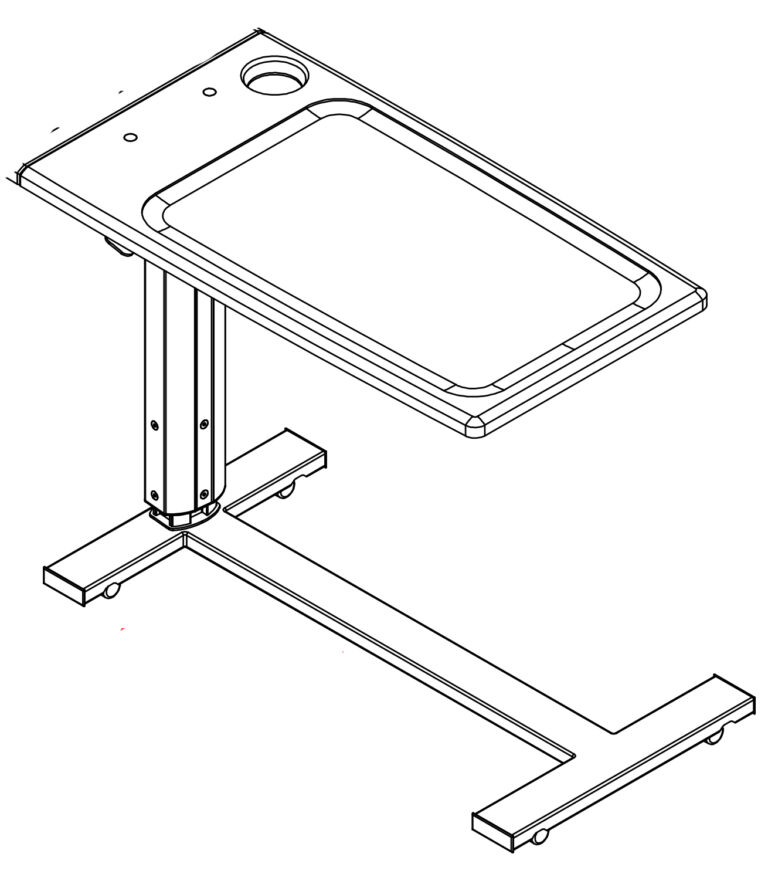
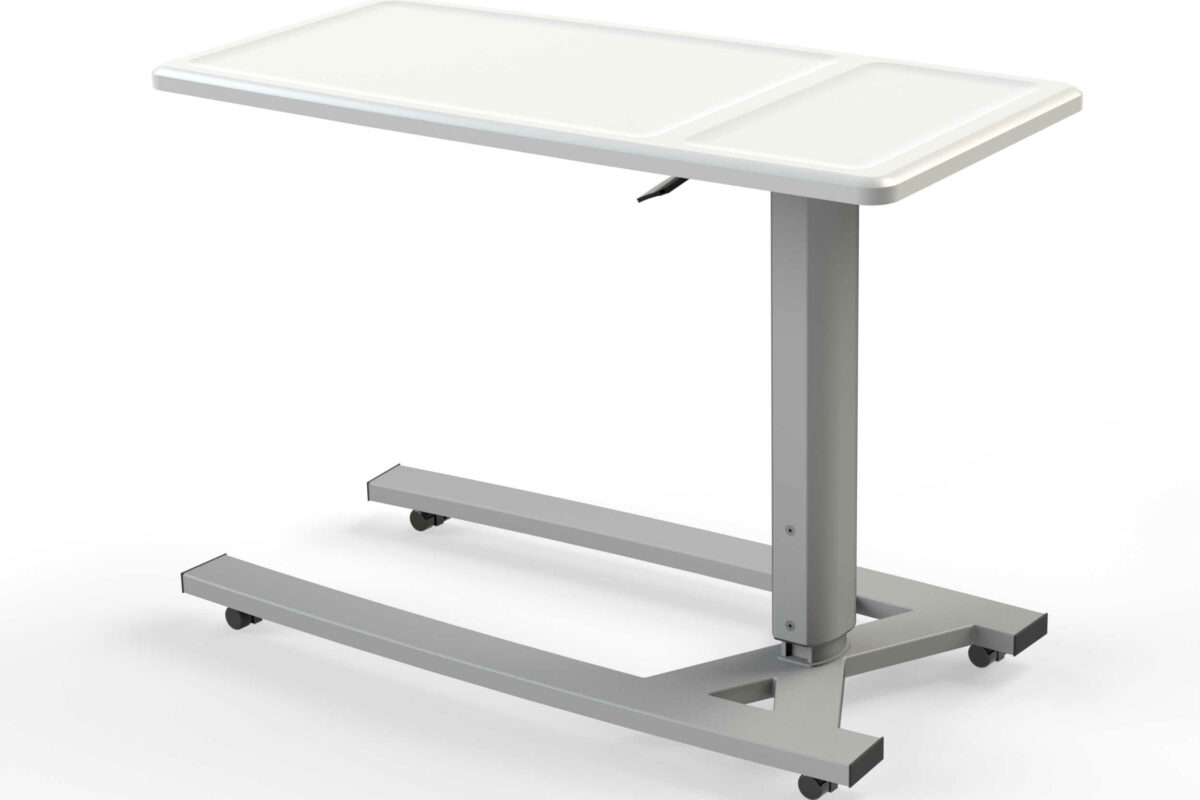
The U-base is designed to serve multiple seating positions, including bed, recliner, and wheelchair. The U-base is often referred to as a C-base also.
In units where patients transition frequently between positions, this geometry reduces the need for repositioning furniture. When properly proportioned, the open design allows compatibility without sacrificing stability.
Best suited for: adaptable environments prioritizing multi-position use.
X-Base Overbed Tables
As surface dimensions increase, proportional base support becomes critical.
The X-base distributes weight across a wider footprint, supporting expanded work surfaces while maintaining balance under off-center load. Stability at larger sizes depends on engineering proportionality between surface area, column rigidity, and base geometry.
Best suited for: rooms requiring larger functional surfaces for charting or multi-item use.
I-Base Overbed Tables
The I-base uses a centered linear footprint that supports maneuverability in tighter rooms.
When bed systems provide reliable under-frame clearance, this configuration offers straightforward positioning and consistent bedside access.
Best suited for: compact rooms with standardized bed platforms.
Specialty Bases for Fifth-Wheel Beds
Fifth-wheel bed systems reduce under-bed clearance and introduce structural obstructions that standard overbed table base geometries cannot accommodate.
A purpose-built solution, the MedViron Sotto Overbed Table for Fifth-Wheel Beds, was designed to maintain both clearance and stability. In these environments, compatibility is a mechanical requirement, not a preference.
Best suited for: facilities utilizing fifth-wheel or center-wheel beds.
Evaluation Criteria
Hospital purchasing teams should evaluate overbed table base types based on:
Bed standardization across the facility
Patient mobility patterns
Room layout consistency
Surface size relative to structural support
Expected lifecycle durability
Facilities that align base selection with bed systems and room standards — rather than surface dimensions alone — typically achieve more consistent long-term performance across units. An overbed table’s long-term reliability is determined less by the size of its top and more by the integrity of its base.
MedViron is exhibiting at the Planning, Design and Construction Summit 2026, March 8–11
About Us
MedViron’s overarching goal is to design and manufacture aesthetically pleasing, high quality extraordinarily cleanable healthcare equipment. Products designed to assist in expeditious and thorough cleaning aid in the all-important quest to reduce the risk of hospital-acquired infections.
We use cookies to ensure that we give you the best experience on our website. If you continue to use this site we will assume that you are happy with it.